Published: 04/15/2026
By Catherine Wu, Global Health Communications Assistant
Amanda Marr Chung, DrPH, executive director of the Stanford Center for Innovation in Global Health (CIGH), has been committed to advancing women’s leadership in her work in global health over the past two decades. For her, gender equity is not abstract, but an everyday reality — both in her research and at home.
Recently, Marr Chung recalled having to juggle a flood of group texts, amidst a closely approaching manuscript deadline, with five other mothers all coordinating a carpooling schedule for their high school sons’ water polo practice. Ironically, the manuscript Marr Chung was preparing was on women’s leadership in global health. Particularly, she had researched women’s underrepresentation in leadership roles while facing barriers like disproportionate caregiving responsibilities — just like the five mothers and herself coordinating carpooling.
“This is just one example of the invisible, unpaid, and undervalued work that women do as caregivers, also known as the second shift,” said Marr Chung.
The manuscript, co-authored by Marr Chung, along with Ola Alani, MS, CIGH research coordinator, and Michele Barry, MD, senior associate dean and director of CIGH, with funding from CIGH-founded nonprofit WomenLift Health, is now published in PLOS Global Public Health. In it, Marr Chung, Alani, and Barry shine light on the specific barriers women face in advancing to leadership roles in global health and underscore the importance of male allyship, in an effort to establish more equitable global health research.
In this context, male allyship is defined as the “purposeful collaboration by males who inherently have more privilege and power with the goal of achieving gender equity through the promotion of women’s voices and accomplishments,” said Marr Chung.
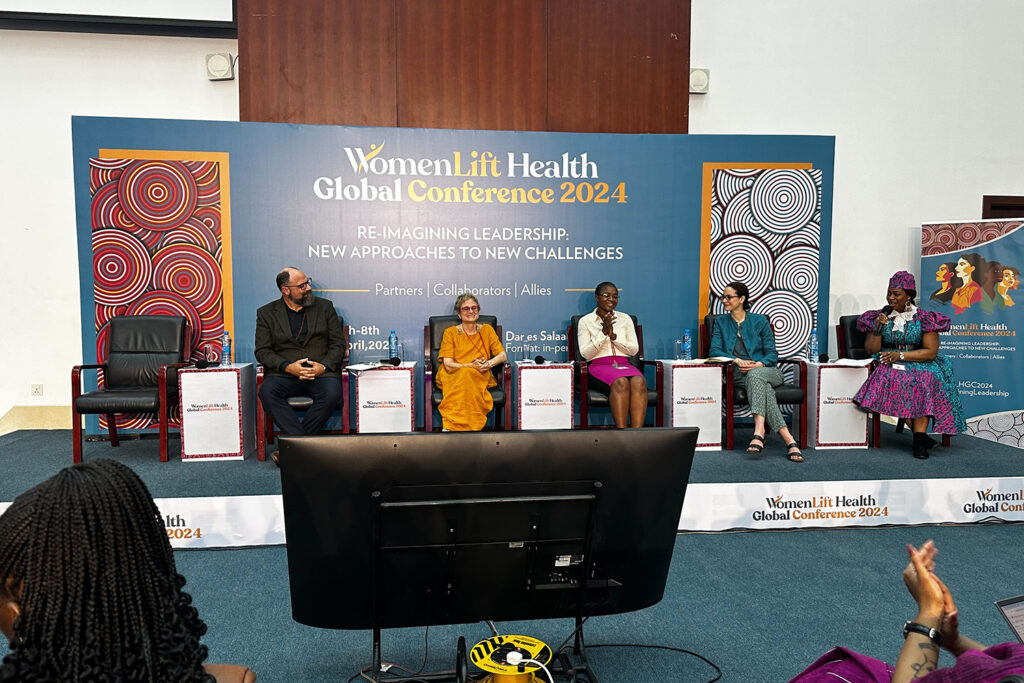
For Barry, who founded WomenLift Health to help women step into leadership positions, “it became crystal clear that male allyship was a crucial factor,” she said. “I believe most men want to be mentors and allies of women colleagues, but at times lack the tools. It was my hope that this study, which was funded by WomenLift, helps give them some of those tools.”
Most men want to be good mentors and sponsors of women colleagues. We hope this paper helps give them some of the tools.
MICHELE BARRY, MD, Senior Associate Dean and Director, CENTER FOR INNOVATION IN GLOBAL HEALTH
Recommendations for effective male allyship
The publication seeks to address a longstanding challenge in global health: Inequitable representation of women in leadership positions. This study advocates for increased male allyship, identifying actions and best practices which can support women’s elevation into leadership roles in the field of global health. Researchers conducted qualitative interviews with 21 global health leaders (11 females, 10 males) across the U.S. and Canada to learn about barriers to women’s advancement to leadership, along with effective approaches to overcoming these barriers.
From these interviews, researchers identified several recommendations for male allies spanning the individual, institutional, and societal levels. Some key recommendations are listed below. A male allyship toolkit is available here.
- Individual level
- Complete a self-assessment (to mitigate counterproductive behaviors and biases)
- Engage in effective mentorship practices
- Advocate publicly
- And serve as a positive caregiving role model
- Institutional level
- Emphasize the importance of cultivating an enabling environment that facilitates open dialogue and collaboration rather than competition
- Establish goals and metrics and make them publicly available
- And integrate required allyship training for all faculty as well as into periodic evaluations and promotion criteria
- Societal level
- Promote early education and shared caregiving to shift cultural norms on gender roles
The authors acknowledged a limitation of this study in only interviewing global health leaders based at academic institutions in the U.S. and Canada, with gaps in representation across ethnicities, gender identities, and institution types. As a next step, they plan to gather feedback from mid-career African physicians and expand research to additional geographic contexts through a global survey.
Why women’s leadership matters
Currently, women make up close to 70% of the global health workforce but only hold 25% leadership positions. When women hold leadership positions, more equitable, inclusive, collaborative workplaces tend to follow. In particular, women leaders have supported climate mitigation and other global health challenges; prioritized the needs of girls, women, and vulnerable or overlooked populations; and increased women participants in research studies.
Women CEOs have increased from 29% to 35% since 2018, women are still far from having equal leadership representation in global health and other sectors. This highlights the persistent need to address structural barriers that continue to shape leadership advancement, the publication’s authors write.
“It’s incumbent upon us as a society to really challenge and discuss gender roles and stereotypes and biases as well as caregiving, power, and privilege, not just in the classrooms but around the family dinner table,” said Marr Chung, describing her appreciation for her own male allies, including her husband and two sons. This is especially urgent with the rise of the manosphere, toxic masculinity, and the increasing potential of AI to harm women and girls, she added.
Marr Chung continued: “This mentality of a rising tide lifts all boats will result in better research, better relationships, and a healthier planet and people.”
This mentality of a rising tide lifts all boats will result in better research, better relationships, and a healthier planet and people.
AMANDA MARR CHUNG, drph, EXECUTIVE DIRECTOR, CENTER FOR INNOVATION IN GLOBAL HEALTH
Read the publication and learn more about CIGH’s women’s leadership and male allyship research here.